 By Galileo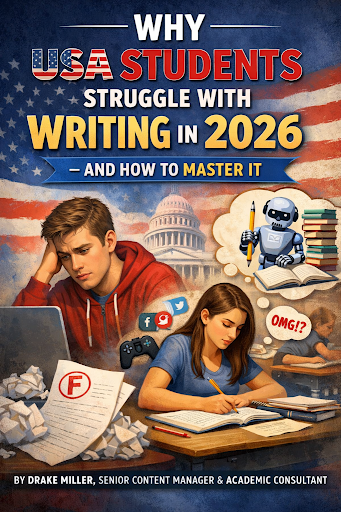
By Drake Miller, Senior Content Manager & Academic Consultant
The transition from a US high school to a university environment has always been a rite of passage, but in 2026, the stakes have evolved. Today’s students are more digitally fluent than any generation before them, yet they face a “writing paradox.” While they can produce vast amounts of digital content, the rigorous, evidence-based demands of scholarly inquiry often feel like a foreign language.
As an academic consultant observing these trends over the last decade, I have seen that the challenge isn’t a lack of intelligence; it is a lack of alignment between high school preparation and the 2026 university standard. Current data suggests that nearly 47% of US college students report that procrastination and writing anxiety negatively impact their GPA. In many cases, connecting with a professional assignment writer can help students deconstruct complex prompts and understand these modern hurdles through the lens of expertise—the first step toward transforming academic writing into a competitive advantage.
For decades, the “five-paragraph essay” was the bedrock of US secondary education. However, 2026 university standards—influenced heavily by AI-detection protocols and a return to “critical human synthesis”—now explicitly penalize mechanical, formulaic writing. Professors are no longer looking for a summary; they are looking for Synthesis.
- The Problem: High schoolers are often conditioned to “fill boxes” (Intro, 3 points, Conclusion).
- The Reality: College-level assignments require an interdisciplinary approach. Students must now weave together sociological data, historical context, and original analysis into a cohesive narrative. This is particularly true in STEM fields; for instance, students struggling to integrate complex data visualizations or technical simulations often seek MATLAB assignment help to ensure their technical execution matches their theoretical arguments. From my experience consulting with students at Tier-1 US institutions, those who fail to break the five-paragraph habit by their sophomore year often see a stagnation in their critical thinking scores.
In 2026, the challenge isn’t finding information—it’s filtering it. With the ubiquity of generative AI, students often fall into the trap of “cognitive disengagement.”
- AI Dependency: Recent studies show that 33% of students face academic integrity reviews due to improper AI use—not necessarily out of a desire to cheat, but because they lack the literacy to use AI as a collaborator rather than a ghostwriter.
- Source Integrity (The E-E-A-T Principle): Many students struggle to distinguish between a peer-reviewed study and a biased, AI-generated blog post. In my role, I emphasize that mastering the E-E-A-T (Experience, Expertise, Authoritativeness, and Trustworthiness) of their own sources is now a mandatory skill. If a student cannot defend the authority of their bibliography, their argument loses its foundation.
The American academic landscape remains a fragmented map of citation styles. Whether it is the APA 7th Edition for psychology, MLA 9th for the humanities, or Chicago/Turabian for history, the technical requirements are exhausting.
- The Burden: When a student is more worried about where a comma goes in a bibliography than the strength of their thesis, the quality of the argument suffers. This “technical friction” is a primary driver of academic burnout I see in freshmen and sophomores.
Writing is a “slow-burn” cognitive process in a world of “fast” digital feedback. The fear of the “blank cursor” leads to chronic procrastination. In fact, research shows that 80% to 95% of college students procrastinate, with about 50% doing so in a way that is consistently detrimental to their health and grades. In 2026, this is exacerbated by the “perfectionism trap”—the idea that every draft must be as polished as the AI-generated content they see online.
To succeed in the current academic climate, students must move beyond “writing harder” and start “writing smarter” using professional-grade frameworks.
Before writing a single word, students should spend 40% of their time on the Structural Framework.
- The Reverse Outline: This is a technique I recommend to all my consulting clients. Write a rough draft, then extract the “core sentence” of each paragraph. If the sentences don’t form a logical staircase, the essay is structurally unsound.
- Thesis Stress-Testing: A thesis shouldn’t just be a statement; it should be a “debatable claim.” If no one can reasonably disagree with your point, it isn’t a thesis—it’s a fact.
Students must learn to use technology as a Scaffold, not a Substitute.
- AI as a “Socratic Partner”: Use AI to challenge your arguments. Ask it, “What are the counter-arguments to my thesis?” This builds the “Expertise” signals that US professors now look for.
- The “Human-in-the-Loop” Rule: Ensure that every piece of evidence is verified by a primary source. In 2026, “hallucination checking” is just as important as spell-checking.
Revision is where the A-grade is earned.
- Global Issues (The Foundation): Does the argument flow? Is the evidence sufficient?
- Local Issues (The Polish): Grammar, punctuation, and citation. Many students flip this, spending hours on a perfect first sentence while the overall logic remains flawed. As a content manager, my rule is: “Fix the foundation before you paint the walls.”
The gap between high school preparation and college expectations is wider than ever. Recognizing when you need a mentor rather than just a tutor is a sign of academic maturity.
In my professional capacity, I have found that resources like Myassignmenthelp.com act as a vital bridge in this transition. By providing high-quality structural examples and expert insights into complex US-specific topics, these platforms help students visualize “what good looks like.” Utilizing these tools is a proactive strategy; it allows students to deconstruct complex arguments and understand the nuances of authoritative writing, effectively shortening the learning curve for high-level scholarly communication.
In high school, the five-paragraph model serves as a training wheel to ensure basic structure. However, university-level inquiry in 2026 demands nuance and complexity that a formulaic approach cannot accommodate. College professors look for your ability to handle “grey areas”—where evidence might be contradictory or multifaceted. A rigid structure often forces students to oversimplify their arguments to fit a template.
Ethical AI use in 2026 is about augmentation, not replacement. Use AI as a “research assistant” or “Socratic partner.” For example, you can prompt an AI to “identify potential counter-arguments to my thesis statement.” However, the moment you allow AI to generate the actual prose, you cross the line into academic misconduct. Always maintain a “human-in-the-loop” approach where every fact is verified by a primary source.
The most frequent error is “citation inconsistency.” Students often start a paper in MLA and accidentally slip into APA-style formatting because they are using automated citation generators without manual oversight. In 2026, with the rise of digital-first research, failing to provide a direct, working DOI or stable URL for online sources is also a major point of deduction.
In 2026, academic writing is no longer just a classroom requirement; it is a prerequisite for the professional world. Whether you are drafting a policy brief, a marketing strategy, or a scientific report, the ability to synthesize data and present a persuasive, evidence-based argument is what separates leaders from followers. By adopting a systematic process, embracing digital literacy, and utilizing professional support, US students can turn their writing struggles into a powerful engine for success.
Drake Miller is a senior content manager and academic consultant. With over a decade of experience in the higher education sector across the USA and UK, Drake focuses on helping students navigate the complexities of digital literacy and E-E-A-T principles in the modern academic landscape.
Stay in touch to get more updates & news on News Ross!