 By Charlotte
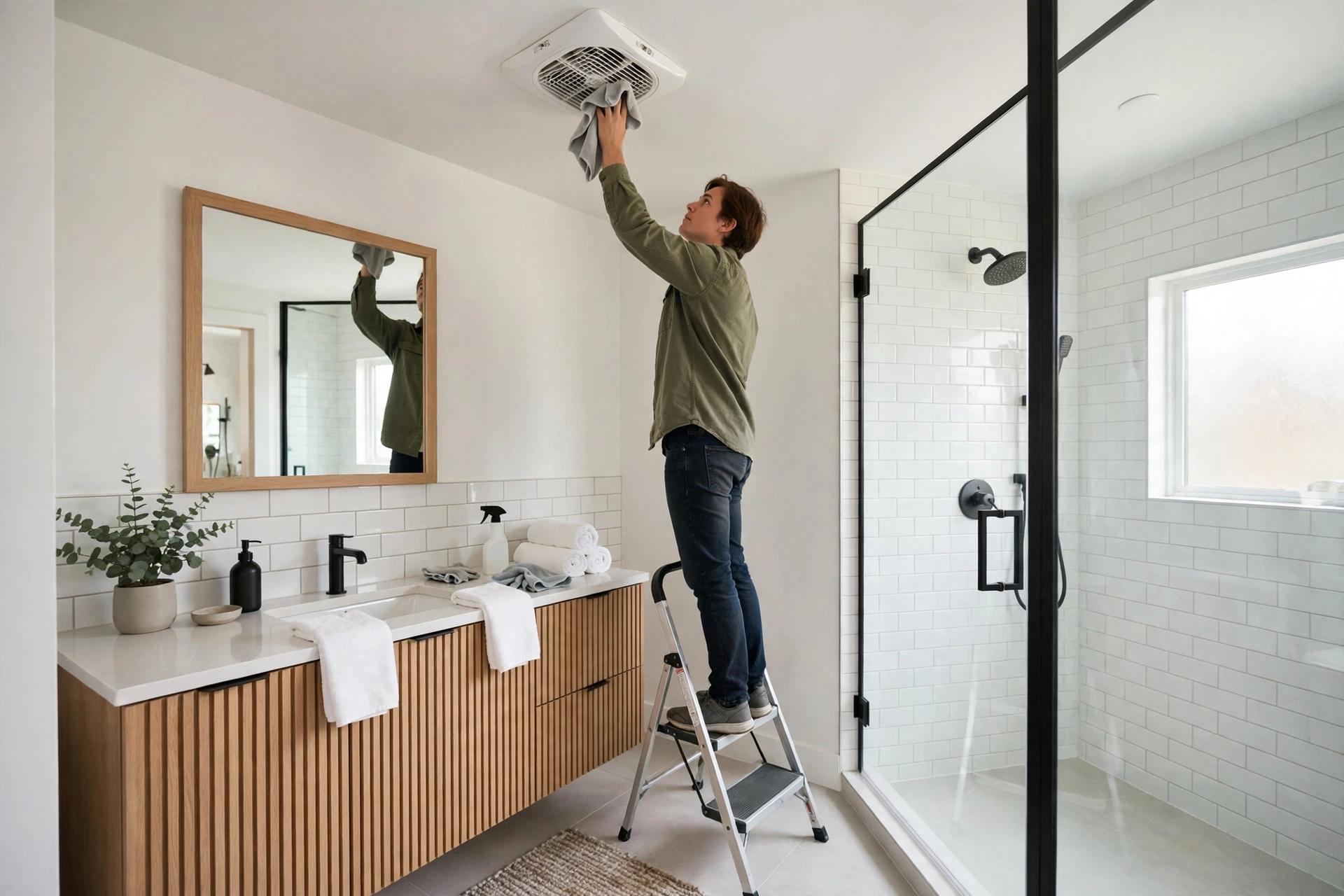
A bathroom exhaust fan is the hardest-working appliance in the house that nobody thinks about. It runs for a few minutes a day, hides behind a grille in the ceiling, and gets blamed for nothing until the day the mirror stays fogged, the paint starts peeling, or a brown stain creeps across the ceiling. By then the damage has been building for months. The good news is that most fan problems are not failures at all. They are maintenance that never happened: a grille choked with dust, a damper stuck shut, a duct full of condensation, or a fan that was never big enough for the room in the first place.
This guide treats the fan as a system, not a single box in the ceiling, because that is how it actually works. Air has to travel from the room, through the fan, along a duct, and out through a roof or wall cap. A blockage anywhere along that path makes the whole thing underperform, and cleaning the visible grille alone will not fix a duct problem two metres away. Work through the system in order and you will know exactly which part needs attention.
The Five-Minute Check That Tells You If Your Fan Is Failing
Start with the simplest test in home maintenance. Turn the fan on, hold a single square of toilet paper up to the grille, and let go. A healthy fan holds the paper firmly against the grille. A weak fan lets it flutter down. It is not a precise measurement, but it is honest: if the fan cannot hold a square of tissue, it is not moving enough air to clear a steamy shower, and no amount of hoping will change that.
While the fan is running, listen. A steady hum is normal. A rattle usually means the grille is loose or the fan wheel is clogged and out of balance. A high-pitched whine often points to a dry or failing motor bearing. A fan that sounds loud but moves little air is usually fighting a blocked duct or a stuck damper rather than dying. Note what you hear before you switch anything off, because the sound tells you where to look next. Also look at the ceiling around the fan. A faint brown ring or bubbling paint near the grille is condensation forming where warm moist air meets a cold surface, and it is an early warning worth acting on.
How a Bathroom Fan Actually Moves Moisture Out of the House
Understanding the path helps you fix the right part. When the fan runs, it pulls humid air out of the bathroom and pushes it through a duct to the outside. That sounds simple, but the air has to be replaced by something, and that something is drier air from the rest of the house, drawn in under the bathroom door or through a vent. If the door fits too tightly against the floor, the fan creates a slight vacuum and its airflow drops sharply. A gap of roughly half an inch to three quarters of an inch under the door is usually enough to let make-up air in, and trimming a door bottom is a straightforward job with a circular saw and a straight edge.
The duct itself matters as much as the fan. A short, straight, rigid duct moves air efficiently. A long run of flexible duct, sagging between joists with several sharp bends, can cut airflow dramatically even with a powerful fan. Every bend adds resistance, and a crushed or kinked section of flexible duct is effectively a closed door. If your fan holds the tissue test weakly despite a clean grille, the duct is the next place to look, and that is usually a job for the attic rather than the bathroom.
Cleaning the Grille, Blades, and Housing Without Damaging the Motor
Cleaning is the single most effective maintenance job you can do, and it takes less time than making a cup of tea once you know the steps. Dust and lint build up on the grille and the fan wheel over months, and that coating acts like a blanket over the blades, reducing airflow far more than people expect. A fan that has not been cleaned in two years can lose a third of its airflow to dust alone. The job is simple, but the order matters, and the one rule is never to spray water or cleaner into the motor.
Switch the fan off at the breaker, not just at the wall switch, so nobody can turn it on while your fingers are near the blades.
Pull the grille down gently. Most grilles are held by spring clips or small screws. If it resists, look for a screw rather than forcing it.
Wash the grille in warm water with mild soap, rinse it, and let it dry fully. A grille that goes back damp will collect dust faster than a dry one.
Vacuum the housing and the fan wheel with a brush attachment, working gently around the blades. Wipe what the vacuum cannot reach with a dry cloth.
Check the motor for dust on its vents and clear them with the brush attachment. Do not oil a sealed motor unless the manual specifically says to.
Refit the grille, restore power, and repeat the tissue test. You should feel and hear the difference immediately.
Do this every three to six months in a bathroom that gets daily use, and more often if the house is dusty or the fan runs a long time each day. Mark it on the same schedule as changing the furnace filter or cleaning the gutters, because a fan that is cleaned on a schedule never gets bad enough to damage the ceiling. If the wheel is caked with grease or the motor hums without spinning freely after cleaning, stop and call an electrician rather than forcing it.
The Damper, the Duct, and the Roof Cap: Clearing the Whole Path
With the grille clean, follow the air out of the house. The damper is a lightweight flap near the fan outlet that stops cold air and pests coming back down the duct when the fan is off. It is a simple thing, but it sticks. Dust, rust, or a bent hinge can hold it half shut, and a half-shut damper strangles airflow while the fan sounds perfectly normal. From the attic side, or through the grille opening if you can reach it, check that the flap swings freely and closes flat when the fan stops.
- Backdraft damper: clean the flap and its hinge, and check it opens fully when the fan runs. A damper that sticks shut is one of the most common hidden causes of a weak fan.
- Duct joints: feel along accessible duct joints for air leaking out. Foil tape, not cloth duct tape, seals joints properly and lasts in a hot attic.
- Flexible duct runs: look for sags, kinks, and crushed sections. Support long runs so the duct stays as straight and as short as possible.
- Roof or wall cap: check the outside vent from the ground or a ladder. Birds nests, leaves, and lint can block the cap, and a cap flap stuck shut is as bad as a blocked duct.
- Duct termination: confirm the duct actually vents outside. A duct that ends in the attic dumps warm moist air straight onto cold timber, which is a recipe for mould and rot.
If you find a duct venting into the attic, treat it as a priority repair rather than a quirk. It is one of the most damaging installation mistakes in a house, because it pumps steam into a cold, dark space every single day. Extending the duct through the roof or a gable wall is a job for a professional if you are not comfortable working in the attic, but it is far cheaper than repairing rotted roof timbers later.
Is Your Fan Big Enough for the Room?
A clean fan in a clean duct can still be too small, and this is where a lot of people get stuck. Fan capacity is measured in cubic feet per minute, or CFM, and the rule of thumb is simple: a bathroom up to 100 square feet needs roughly one CFM per square foot, with a minimum of 50 CFM. Larger bathrooms, bathrooms with high ceilings, and bathrooms where several people shower one after another need more. If your fan is rated at 50 CFM and your bathroom is 120 square feet with a nine-foot ceiling, it was never going to keep up, and no amount of cleaning will change that.
| Bathroom size | Minimum fan rating | When to go bigger | Typical result if undersized |
|---|---|---|---|
| Under 50 sq ft | 50 CFM | High ceiling or no window | Mirror fogs, paint peels slowly |
| 50 to 80 sq ft | 60 to 80 CFM | Two people shower daily | Steam lingers after showers |
| 80 to 100 sq ft | 80 to 100 CFM | Shower and bath both used | Ceiling condensation in winter |
| Over 100 sq ft | 110 CFM or more | High ceiling, jetted tub | Persistent damp, mould risk |
| En-suite with steam shower | 150 CFM or more | Always | Fan runs constantly, still damp |
Timers and Humidity Sensors That Stop the Twenty-Minute Guessing Game
The most common user error with bathroom fans has nothing to do with the fan itself. People switch it off the moment the shower ends, and the steam that is still hanging in the air settles on the ceiling as it cools. The fix is to run the fan for at least twenty minutes after the shower, and the reliable way to make that happen is to stop relying on memory. A timer switch that runs the fan for a set period after you leave the room costs little and removes the guesswork entirely.
Insulating the Duct So Steam Does Not Turn Back Into Water
Here is the problem that causes the brown ring around the fan that so many people mistake for a roof leak. Warm moist air travelling through a cold attic duct cools down, and the moisture condenses inside the duct. That water runs back down and drips onto the ceiling around the fan, staining the paint and feeding mould. The fix is insulation around the duct, which keeps the air warm enough to stay as vapour until it leaves the house.
If you are installing a new fan, buy insulated duct from the start. For an existing installation, wrap the accessible duct in insulation in the attic, taking care not to compress it, since squashed insulation barely insulates. In a cold climate, also insulate the fan housing itself where it sits in the attic, and make sure the attic insulation is not blocking the soffit vents that keep the attic dry. A small amount of insulation in the right place prevents a stain that would otherwise need a ceiling repair.
When Noise, Smell, or Stains Mean Call a Professional
Some symptoms are beyond cleaning and adjustment. A fan that grinds, squeals, or hums loudly without moving air usually has a failing motor or a bent wheel, and running it in that state risks overheating. A persistent musty smell that cleaning does not fix can mean mould inside the duct or in the ceiling cavity, which needs proper investigation rather than air freshener. And a ceiling stain that keeps coming back after the duct is insulated may be a roof leak or a plumbing leak rather than condensation, which is a different trade entirely.
Call an electrician for wiring, a humming motor, or any fan that trips a breaker. Call a roofer if the stain is near the roof cap or if the cap flashing looks damaged. Call a ventilation specialist if the duct run is long, convoluted, or inaccessible, because re-routing a duct properly is a job that pays for itself in a dry ceiling. None of these calls is a failure. They are the point where a maintenance job becomes a repair, and knowing the difference is what keeps a small problem small.
Final Thoughts on Keeping a Bathroom Fan Working Hard for Years
A bathroom fan asks for almost nothing: a clean grille twice a year, a free damper, a clear duct, and twenty minutes of running time after each shower. Give it that and it will quietly protect your ceiling, your paint, and your air for a decade or more. Ignore it and it will fail slowly, staining the ceiling long before it stops spinning. The maintenance takes less time than the repair, every single time.
Bathroom Exhaust Fan Maintenance Questions, Answered
How often should I clean my bathroom exhaust fan?
Clean the grille and fan wheel every three to six months in a bathroom used daily. A quick vacuum of the grille monthly helps in dusty homes. If the mirror stays fogged after showers, clean the fan before assuming it needs replacing.
How long should I run the fan after a shower?
At least twenty minutes after the shower ends. Steam stays in the air long after the water stops, and switching the fan off early lets it settle on the ceiling. A timer switch or humidity sensor automates this so you do not have to remember.
Why is there a brown stain around my bathroom fan?
It is usually condensation forming inside an uninsulated duct in a cold attic, then dripping back onto the ceiling. Insulating the duct and the fan housing normally fixes it. If the stain returns after insulation, have a roofer check for a leak near the vent cap.
What size exhaust fan does my bathroom need?
Roughly one CFM per square foot of floor area, with a minimum of 50 CFM for small bathrooms. Larger rooms, high ceilings, and steam showers need more. Check the rating on your existing fan before assuming it is too small, since a dirty fan can seem undersized when it is only clogged.
Can I vent a bathroom fan into the attic?
No. Venting into the attic dumps warm moist air onto cold timber, which causes mould and rot over time. The duct must run to the outside through the roof or a wall. If you discover your fan vents into the attic, extending the duct outside is a priority repair.
What if the fan is loud but moves very little air?
A loud fan that moves little air is usually fighting a blocked duct or a stuck damper, not a dying motor. Clean the grille and wheel, check the damper swings freely, and inspect the duct for kinks or a blocked roof cap before assuming the fan needs replacing.
 Galileo