 By Zarshal seo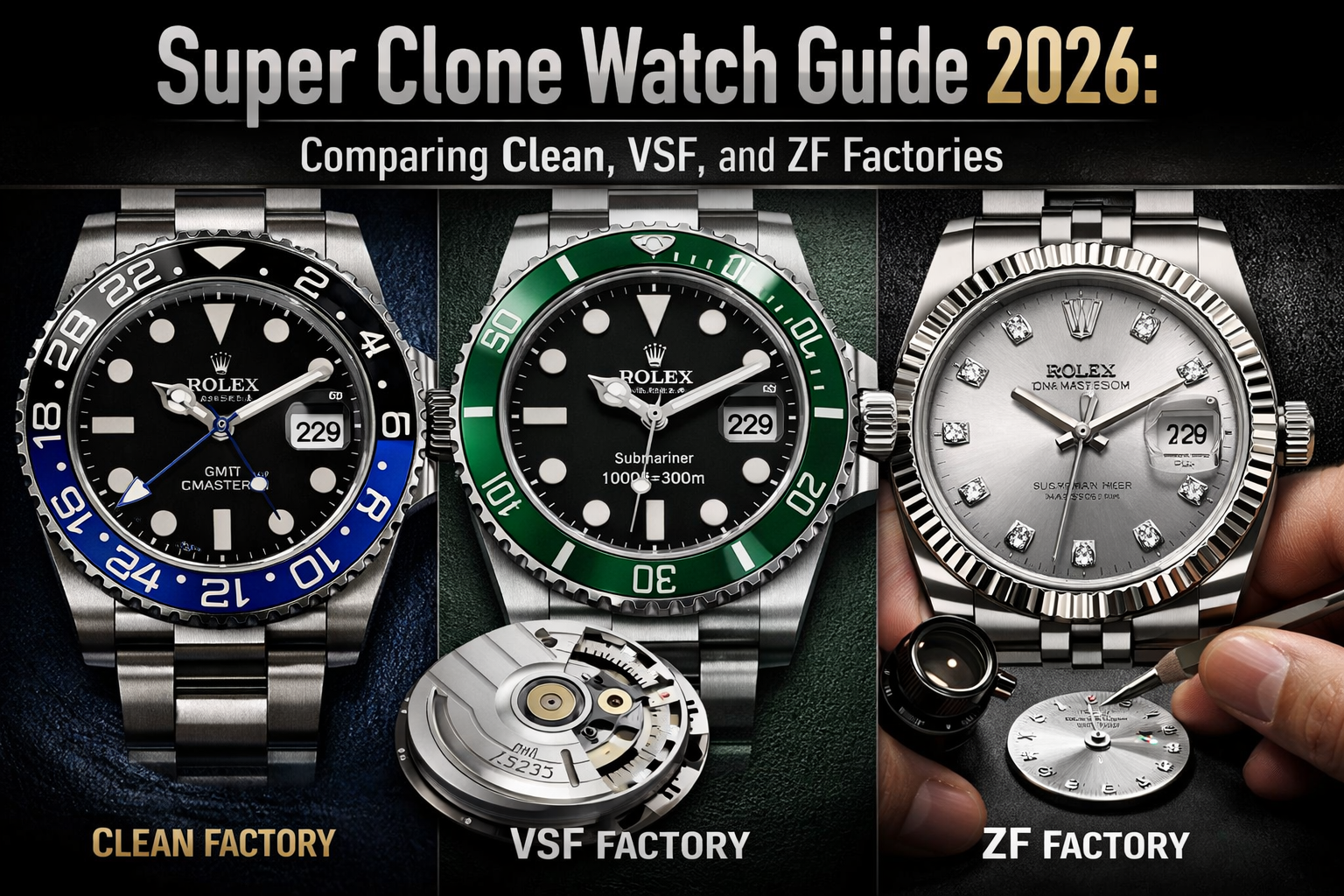
Most buyers entering the world of superclone watches quickly realize that the real confusion isn’t about choosing a model it’s about choosing the right factory. Clean, VSF, and ZF are constantly compared, yet very few sources explain why one feels closer to genuine Rolex than another in real-world use.
Here’s the direct answer: VSF leads in movement engineering, Clean dominates external finishing, and ZF excels in select model executions. Understanding these differences is critical, especially for USA buyers who prioritize reliability, accuracy, and long-term wear.
This guide breaks down the technical reality behind these factories from movement architecture to case finishing—so you can make a decision based on performance, not marketing noise.
The term superclone watches often gets used as a blanket label, but the gap between factories is substantial. High-end producers like VSF, Clean, ARF, APS, and 3K—based in China operate with advanced CNC machining, proprietary movement builds, and material standards that replicate genuine watchmaking principles. These watches are sold globally, with the USA representing one of the largest buyer markets.
What separates a top-tier Rolex Superclone from a lower-tier replica isn’t just appearance—it’s how the watch behaves over time. Gear train efficiency, amplitude stability, and sealing quality all affect daily performance. Two watches may look identical in photos, but only one will maintain consistent timekeeping, smooth winding, and proper date transition under real use.
For collectors across the USA market, especially in cities like New York and Los Angeles, these technical differences are the deciding factor not just aesthetics.
At the core of any serious superclone is its movement architecture. The VS3235 caliber, used in many VSF models, is a fully integrated clone movement designed to mirror Rolex’s 3235 platform. It features an optimized gear train that reduces friction loss, allowing more efficient energy transfer from the mainspring to the escapement.
This matters because improved efficiency directly impacts amplitude stability—the consistent swing of the balance wheel. In practical terms, a stable amplitude means better timekeeping and less deviation during daily wear.
The escapement system, working alongside the balance wheel, regulates energy release. VSF’s execution closely follows genuine Rolex geometry, resulting in smoother second-hand motion and reduced positional variance. Lower-tier movements often suffer from erratic amplitude drops, especially after extended wear, which leads to time drift.
Rotor winding efficiency is another overlooked factor. In VSF builds, the rotor engages the winding system with minimal resistance, allowing faster power reserve recovery during normal wrist movement. This contributes to a more consistent power reserve profile, often approaching the 70-hour benchmark seen in genuine Rolex movements.
For chronograph models like the Daytona, the DD4130 movement stands out. Unlike modified base calibers, it replicates the genuine Rolex chronograph layout, including the column wheel and vertical clutch system. The result is a smoother pusher feel and precise chronograph engagement without the lag or stutter seen in inferior builds.
Beyond movement, material quality plays a critical role. High-end superclone watches use 904L stainless steel, which offers improved corrosion resistance and a brighter polish compared to 316L. Combined with precision CNC machining, this ensures consistent case geometry, sharp lug transitions, and accurate bezel alignment.
Dial printing and rehaut engraving are also critical. Clean Factory, in particular, achieves high accuracy in text spacing, font weight, and engraving depth, which significantly affects how “genuine” the watch appears under close inspection.
Finally, waterproofing is not just marketing language. High-end superclones are built with proper gasket systems, screw-down crowns, and sealed casebacks, making them genuinely waterproof under normal use conditions, not merely splash-resistant.
VSF has built its reputation on movement engineering. Its proprietary calibers, particularly the VS3235 and VS3135, are designed for long-term mechanical stability. In real-world use, VSF watches maintain consistent amplitude and smooth winding behavior even after extended wear cycles.
The factory focuses less on cosmetic perfection and more on internal performance. For models like the Submariner and Datejust, this approach results in watches that feel mechanically refined and reliable for daily use.
Clean Factory approaches the problem from the opposite direction external perfection. Case finishing, bezel construction, and dial execution are where Clean stands out. The ceramic bezels, especially on GMT Master II models, show accurate color transitions and precise engraving depth.
Bracelet construction is another strong point. The clasp mechanism feels solid, with tight tolerances and minimal play. For buyers who prioritize visual accuracy particularly under magnification—Clean often delivers the closest match to genuine.
ZF operates as a specialist factory, focusing on select models where it can deliver strong value. While it may not lead in movement engineering or finishing across the board, ZF excels in dial detailing and niche executions.
For certain Datejust and Tudor-inspired builds, ZF provides a balance between cost and quality that appeals to collectors looking for variety without compromising too much on performance.
ARF is known for bracelet construction and case finishing, often producing some of the best-feeling bracelets in the superclone market. APS focuses on complex movement builds, particularly in chronograph and skeletonized designs. 3K has gained recognition for its work on integrated bracelet models and slim-profile movements.
Each of these China-based factories contributes to the broader ecosystem, offering different strengths depending on the model and use case.
When comparing superclone watches, the factory choice becomes even more important at the model level.
For the Submariner, VSF remains the preferred option due to its movement reliability and strong waterproofing. Clean offers slightly sharper bezel finishing, but VSF delivers better daily performance.
In the GMT Master II, Clean dominates with bezel accuracy and dial execution. The color transitions on ceramic inserts are closer to genuine, making it the top choice for collectors focused on aesthetics.
The Daytona benefits from the DD4130 movement, typically paired with Clean Factory builds. This combination delivers both visual accuracy and authentic chronograph function.
For the Datejust, VSF leads due to the VS3235 movement, offering smooth date changes and stable timekeeping. ZF provides alternatives with strong dial variations for buyers seeking different configurations.
Choosing between factories comes down to how you intend to use the watch. Buyers across the USA typically evaluate three core factors: mechanical performance, visual accuracy, and long-term reliability.
A daily wearer benefits from VSF’s movement stability, while a collector showcasing pieces may prefer Clean’s finishing precision. ZF fits buyers who want specific models without paying a premium for top-tier builds.
The key is aligning the factory’s strengths with your priorities, rather than chasing a single “best” option.
A buyer in Miami purchasing a Submariner for daily wear needs dependable waterproofing, consistent timekeeping, and durability in humid conditions. VSF’s engineering makes it the logical choice.
In contrast, a collector in Los Angeles focused on a GMT Master II for visual appeal will likely choose Clean due to its superior bezel and dial execution.
These scenarios highlight a simple truth: performance differences become obvious over time, not in photos.
Pricing in the superclone watches market reflects movement complexity, material quality, and finishing precision. A Daytona with a DD4130 movement commands a higher price because of its fully integrated chronograph system.
Similarly, watches using 904L steel and advanced CNC machining processes justify higher costs due to durability and finishing accuracy.
For buyers, value is not about the lowest price—it’s about how closely the watch replicates genuine performance and feel.
For a deeper understanding of how to evaluate build quality, many collectors refer to this
1:1 Superclone authentication guide
to distinguish high-end models from lower-tier replicas.
High-end superclone watches operate on the same mechanical principles as genuine watches, which means maintenance matters. Regular servicing every two to three years ensures proper lubrication and consistent performance.
Factors affecting longevity include:
- Movement lubrication and wear
- Rotor efficiency
- Gasket integrity for waterproofing
With proper care, these watches are capable of long-term reliable performance, making them suitable for daily wear.
The USA remains a major market for superclone watches, with strong demand in cities like New York, Los Angeles, Miami, Chicago, Houston, Dallas, and San Francisco.
Buyers across the USA typically compare:
- Factory reputation
- Movement reliability
- Shipping consistency
- Seller credibility
New York buyers often favor Datejust and Daytona models, while Miami shows strong demand for Submariner and Yacht-Master. Los Angeles collectors tend to prioritize visual perfection, making Clean Factory particularly popular.
Choosing the right factory is only part of the equation the source matters just as much. Superclonewatch positions itself as a trusted supplier by focusing on verified factory sourcing, quality control, and accurate product representation.
This ensures buyers receive the correct factory build, not a downgraded version marketed as premium. For serious collectors and first-time buyers alike, this level of transparency significantly reduces risk.
The superclone market in 2026 is defined by specialization. VSF delivers mechanical precision, Clean leads in finishing, and ZF offers strong alternatives in specific models. Understanding these differences allows buyers to choose based on real performance not assumptions.
For collectors in the USA and beyond, the smartest approach is to match the factory to your intended use. Whether you prioritize reliability, aesthetics, or value, the right combination exists.
 ZeeHQ
ZeeHQ  Galileo